Instructional Agents: A Faculty Meeting Inside an LLM
Ask any instructor what eats their time, and "preparing course materials" is near the top. A single course needs learning objectives, a syllabus, slides, lecture scripts, and assessments — and they all need to be coherent with one another. In a well-resourced department, that work is shared among faculty, instructional designers, and teaching assistants. In an under-resourced one, it lands on one overstretched person. Instructional Agents is our attempt to package that whole collaborative process into a multi-agent LLM system.
Beyond one-task tools
Plenty of AI tools handle isolated slices of teaching — a quiz generator here, a grading assistant there. What's been missing is an end-to-end workflow that produces a complete, internally consistent course package. The risk with piecemeal tools is exactly the fragmentation good course design tries to avoid: objectives that don't match the assessments, slides that drift from the syllabus.
Our key design choice is to simulate the team, not just the task. Instructional Agents spins up role-specialized agents — a Teaching Faculty agent (the primary authority), an Instructional Designer, a Teaching Assistant, a Course Coordinator, and a Program Chair — and has them collaborate the way a real curriculum-development team would.
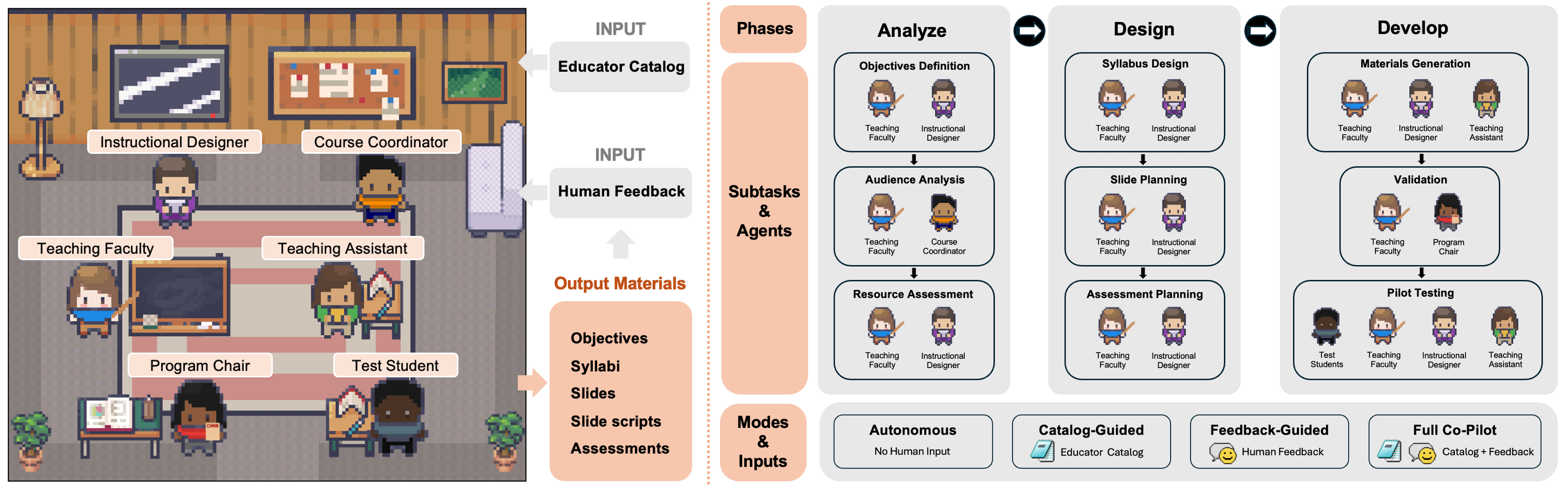 Overview of Instructional Agents. Left: educator input and human feedback drive the generation of learning objectives, syllabi, slides, slide scripts, and assessments. Right: role-specialized agents collaborate across the Analyze, Design, and Develop phases of the ADDIE framework.
Structured by ADDIE
Rather than letting the agents improvise, we ground the workflow in ADDIE — a standard instructional-design framework — and implement its first three phases:
- Analyze — the Teaching Faculty agent sets the instructional objectives while the Course Coordinator supplies context (student background, constraints). The output is an Instructional Foundation Report that grounds everything downstream.
- Design — Faculty and Instructional Designer agents jointly build the syllabus, plan the slide flow, and design assessments (including a multi-stage capstone in place of a traditional exam), keeping objectives, content, and assessment aligned.
- Develop — the Teaching Assistant agent turns the plans into concrete LaTeX slides, slide scripts, and finalized assessments; the Program Chair reviews at the program level; and a simulated Test Student surfaces confusing or mispaced material for refinement.
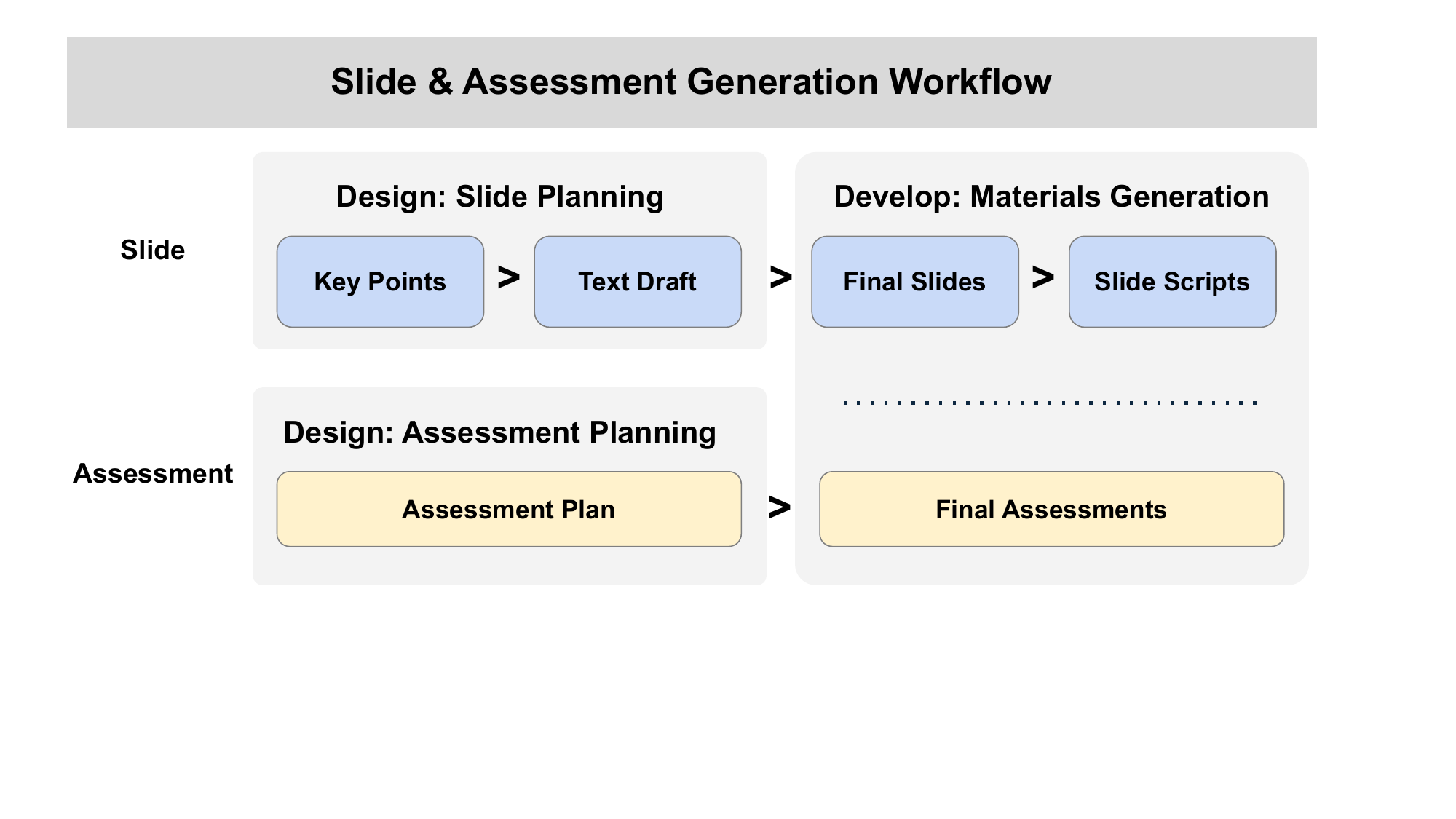 From key points and drafts to final slides, slide scripts, and assessments — the generation workflow bridging the Design and Develop phases.
We deliberately stop before ADDIE's Implement and Evaluate phases. Those require deploying materials to real students, and we believe AI-generated content should pass human review first.
Four modes, one dial for human involvement
Different instructors want different amounts of control, so the system runs in four modes that slide from fully automated to fully collaborative:
- Autonomous — give it a course name and walk away. Best for rapid prototyping and benchmarking.
- Catalog-Guided — seed the agents with an
Educator_Catalogof institutional policies, existing course structures, and prior feedback, so outputs stay consistent with departmental standards. - Feedback-Guided — let the system run, then review and request targeted regeneration of specific pieces without restarting the pipeline.
- Full Co-Pilot — the system pauses after each subtask for the instructor to approve, edit, or redirect. The most hands-on, and — as the results show — the highest quality.
Across all human-in-the-loop modes, the Teaching Faculty keeps final approval. The system is built to support faculty, not replace them.
What we found
We evaluated Instructional Agents on five university-level courses (Data Mining, Foundations of ML, Data Processing at Scale, Intro to AI, and Topics in RL), using an adapted Quality Matters rubric, with both human expert reviewers and LLM reviewers scoring six outputs on a 1–5 scale.
Cheaper models hold their own. Comparing GPT-4o, GPT-4o-mini, and o1-preview as backends, a Friedman test found no significant difference in quality (Q = 0.473, p = 0.789). Since GPT-4o-mini is by far the cheapest, it became our default backend.
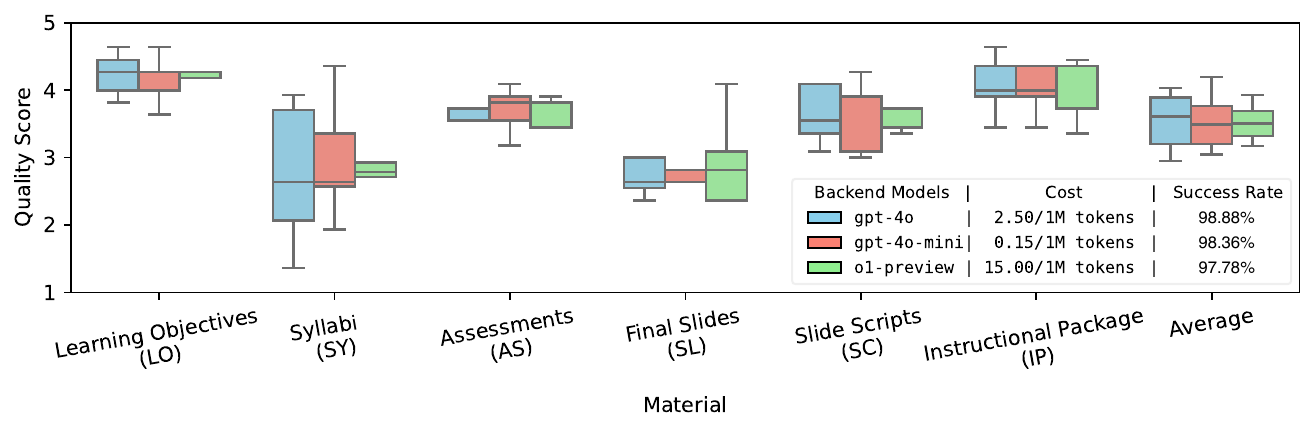 Quality, cost, and success rate across three LLM backends. GPT-4o-mini matches GPT-4o and o1-preview on quality while costing the least.
More human involvement means better materials. Full Co-Pilot mode consistently scored highest — about 0.5 to 0.9 points above Autonomous mode — with the biggest gains in Learning Objectives, Slide Scripts, and the overall Package. Each mode trades refinement against effort: Catalog-Guided shines on structural pieces (objectives, syllabi), while Feedback-Guided does well on content-heavy ones (assessments, slides).
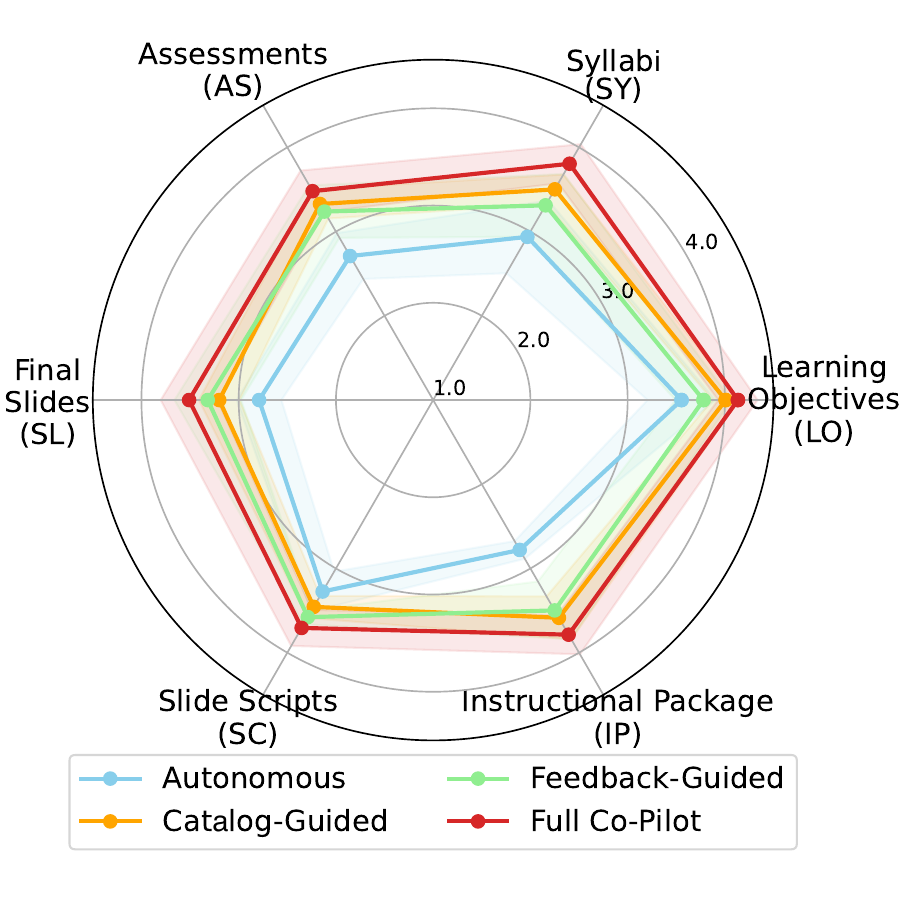 Radar chart of human-rated quality across material types for each operational mode. Full Co-Pilot covers the most area.
Two findings worth flagging:
- Roles aren't decoration. Ablating any single agent hurt quality, and the single-agent baseline was the worst of all (avg 2.33 vs. 3.74 for full Co-Pilot). Drop the Instructional Designer and learning-objective clarity collapses; drop the Teaching Assistant and slide/LaTeX consistency suffers. Role specialization is a genuine design requirement, not a flourish.
- LLMs make poor judges. As automated reviewers, LLMs clustered their scores tightly around 3.0, while human reviewers spread their judgments across the full range. LLM evaluators struggle to tell great work from mediocre — so we treat human assessment as the ground truth.
The cost side is striking: a full course package runs on the order of $0.22–$0.36 in compute, with human time ranging from zero (Autonomous) to 30–45 minutes (Co-Pilot).
Why it matters
The point isn't to take instructors out of the loop — it's to lower the barrier to good course design for the institutions that need it most. Community colleges, international programs, and under-resourced departments rarely have dedicated instructional-design staff. A system that drafts a coherent, rubric-aligned course package for under a dollar, then hands it to faculty for review and refinement, is a step toward more equitable access to high-quality education.
The project website and source code are available at darl-genai.github.io/instructional_agents_homepage.
Links: Project page · All publications — accepted at EACL 2026.